DORKK JOURNAL History and Learning
Two Memories, One Street
When two people remember a local place differently, history gets interesting. A South African family guide to interviews, photographs and careful conclusions.
The photograph shows a small shop, a striped awning and a bicycle leaning against the wall. A learner puts it on the table and asks when the shop opened.
One adult remembers buying bread there before starting secondary school. Another is certain the shop arrived much later, after the road was resurfaced. Both sound confident. The learner looks from one to the other. Surely history is supposed to have an answer?
This is a fictional scene, not a reported interview. But it gives us a useful place to begin. The interesting question is no longer simply when a shop opened. It is what each person means by “the shop”, which part of its history they encountered, and what other information might help.
A building can change owners without changing its shape. A trading name can survive a move. A person can remember their first visit more clearly than the opening date. None of those explanations should be accepted just because they sound plausible. They are possibilities to investigate.
That is a more generous, and more demanding, version of learning History than deciding which adult has won the argument.
A history lesson close to home
South African learners do not have to begin with a famous monument to ask worthwhile historical questions. An ordinary place can bring pictures, written records, objects and recollections into the same investigation.
There is a specific curriculum connection here. The Department of Basic Education’s 2011 CAPS Social Sciences document for Grades 4–6 places Local History in Grade 4 History, Term 1. It includes finding information through pictures, writing, stories, interviews and objects. Its suggested local-history project is adaptable to available resources. This article is an enrichment activity, not a replacement for a teacher’s project brief or a claim about what every class should be doing this November. DBE CAPS, printed pages 15 and 34
The curriculum’s choice matters. It puts several ways of knowing alongside one another. A handwritten note is not automatically better than a spoken account; a confident recollection is not automatically better than a dated photograph. Each needs to be examined for the particular question being asked.
For younger learners, keep the language simple: “What does this help us find out?” is more useful than demanding an impressive definition of evidence. Older learners can take the same task further by comparing accounts, explaining uncertainty and showing why one conclusion fits the available material better than another.
Narrow the question before collecting the stories
“The history of our town” is a large assignment. “What was sold in this building before it became a bakery?” is small enough to explore without pretending to explain everything.
In our fictional example, the family chooses this question: Was there a bread shop in this building by 1998? This is deliberately different from asking when the current business began. The distinction gives the learner something to test.
Before an interview, they make three spaces on a page: what we already have, what we think it might mean, and what we still need to know. In the first space goes “photograph showing a striped awning”. In the second goes “possibly the shop the adults remember”. In the third goes “date, photographer and exact building not yet confirmed”.
Notice how much weaker the first space would be if it said “proof that the bakery opened in 1998”. That conclusion would be travelling ahead of the information.
A parent can help by asking the learner to separate what is visible from what has been supplied by somebody else. This is not a trick designed to catch mistakes. It is a way to stop a sensible guess from quietly becoming an established fact.
Start with permission, not the record button
Someone agreeing to a friendly conversation has not necessarily agreed to a recording, a classroom presentation or a public social-media post. Decide what the activity involves before inviting anyone to participate.
The Oral History Association’s ethics guidance emphasises informed agreement, clear explanations of use, opportunities for review and respect for a narrator’s refusal to answer. These are professional principles from a US-based association, not a statement of South African school law. A school’s own safeguarding and consent procedures still apply. OHA Statement on Ethics
For a family activity, an adult should arrange and supervise contact. Choose an ordinary, comfortable topic and a person who wants to discuss it. A learner should not approach strangers alone or be expected to uncover private family history. If the conversation becomes uncomfortable, stop or change the subject. A finished worksheet is not more important than someone’s boundaries.
Agree whether the learner will take notes or record, who will see the result, and whether the person’s name can appear. Keep addresses, contact details and unrelated personal information out of the work. Do not upload the recording to an online service simply because it offers quick transcription. That would introduce another audience and another use to consider.
A simple question such as “May I write about the shop you remember and show the paragraph to my teacher?” is much clearer than “Can I use your story?”
Ask a question that leaves room for the answer
A learner may arrive with a theory. That is fine, provided the theory does not become the interview script.
“Was the bakery already there in 1998?” invites a short answer and supplies the date. “What do you remember about buying food in that street?” opens a wider account. A follow-up can then ask which building the person means, what they bought and how they place the memory in time.
The OHA’s interviewing guidance recommends open questions and follow-up clarification. It also recognises that the person being interviewed may identify something important outside the interviewer’s original focus. Oral History Best Practices
Here are original prompts for our fictional shop investigation, rather than a questionnaire to copy into every school assignment:
- What did you call the shop at the time?
- What could you see beside it?
- What do you remember doing there yourself?
- Is the date something you remember directly, or have you worked it out from another event?
- Is there a photograph, receipt or other record you would be comfortable showing us?
These questions do different jobs. A landmark can help distinguish two similar buildings. A personal experience can distinguish witnessing an event from hearing about it later. A date question can reveal whether “1998” is a precise recollection or an estimate.
A helpful interviewer does not fill every silence. Nor should a parent correct an adult’s story on the learner’s behalf. If an answer is unclear, the learner can say what they understood and ask whether that is right. Listening carefully includes allowing the speaker to correct the questioner.
Keep the voice, but do not invent the words
After the conversation, there are two different writing tasks: recording what someone said, and explaining what the learner thinks it means. They should not be mixed without warning.
If the learner has accurate words in a permitted recording or checked notes, a short quotation may be appropriate. If only the gist was written down, paraphrase it and say whose recollection it is. Do not put a polished sentence in quotation marks because it sounds like something the person might have said.
For example, our fictional learner might write: “The first interviewee remembers buying bread there before starting secondary school, but was not certain of the year.” That is more useful than replacing the uncertainty with a confident date.
A conversation may happen in a language different from the language of the school assignment. Preserve the original meaning rather than making the speaker sound artificially formal. Label a translation or translated summary, and ask a trusted adult or the speaker to check a difficult phrase where possible. If a word has no easy equivalent, a short explanation can be better than a misleading substitute.
Edutopia’s practitioner article on multilingual oral-history projects discusses interviewing in a family member’s chosen language. It offers teaching ideas, not proof that this particular activity will improve a South African learner’s marks. Vong, 2022
Three sources that seem to disagree
Now imagine that the learner has assembled the following entirely invented teaching materials. The dates, people and businesses are fictional; this is not a real local case study.
Account A: One person remembers buying bread in the building before starting secondary school in 1998. They remember a different shop name, but cannot recall its spelling.
Account B: Another person recalls the current bakery opening after the road resurfacing in 2004. They did not live nearby before 2001.
Record C: An imaginary community newsletter dated March 1997 announces that a general dealer at that address sells bread on weekday mornings. The fictional address matches the building in the exercise.
The temptation is to choose Account A and declare Account B wrong. But read the question again. We wanted to know whether bread was being sold in the building by 1998, not whether the present bakery existed then.
Record C supports bread being advertised for sale in 1997. It does not by itself prove that every advertised sale happened, identify the first day of trading, or establish continuity into later years. Account A adds a recollection of buying bread before 1998. Account B might describe a later business, and its speaker’s absence before 2001 limits what their personal experience can tell us about earlier trading.
A careful conclusion would be: “The newsletter and the first account support bread being sold at the building before 1998. The second account may concern a later bakery. We have not established when the first shop opened or whether the businesses were connected.”
This is a stronger answer than “both people were right”. It identifies what is supported, offers a possible explanation for the difference and keeps that explanation provisional.
A photograph is evidence, not a complete explanation
Return to the striped awning. A photograph can show a sign, an arrangement of windows or an object that helps identify a place. But its usefulness depends on what we know about it.
Who took it? Is the date recorded on the original, added later in an album, or guessed from someone’s clothing? Are we seeing the whole image or a crop? Does a handwritten caption refer to the photograph or to a nearby one? These are questions for investigation, not reasons to distrust every family album.
In our invented exercise, suppose the photograph has “1996” written on its back. The learner should record that inscription without silently assuming it is the exposure date. A useful note is “date written on the reverse; writer unknown”. If the photographer later confirms when and where it was taken, the note can be updated with that additional source.
The physical photograph should be handled with the owner’s permission. A learner can describe it without taking the original to school. If a copy is allowed, keep the whole image as well as any detail used for discussion, and preserve the caption context. A neat crop can accidentally remove the very clue that changes an interpretation.
The best answer may include an unfinished sentence
“We do not yet know…” can be the most honest line in the project, provided the learner explains what remains uncertain.
There is a difference between not knowing anything and knowing the limits of a conclusion. In the fictional shop exercise, the learner can support an answer about bread sales before 1998 while still lacking an opening date. The next useful record might be an older advertisement or a dated business notice, not another retelling of the same story.
Equally, three web pages repeating one account are not three independent witnesses. Ask where each version came from. If a community website copied a newsletter and a social post copied that website, the chain leads back to one underlying source.
This does not mean a school learner must become a professional archivist. It means a small project can be clear about its boundaries. A parent can model that by saying, “That would be interesting to check”, rather than supplying an unverified answer to make the paragraph feel complete.
Make something readable, not merely decorative
A display full of old-looking paper can be attractive without explaining anything. Give the learner a manageable output: one question, two or three labelled pieces of information, a short conclusion and one unresolved point.
For our fictional example, the photograph’s label would distinguish the visible shopfront from the unconfirmed date. The interview label would identify it as a remembered account and preserve the speaker’s uncertainty. The newsletter label would explain what was advertised, without turning the advertisement into proof of an opening ceremony.
Then the learner can write a paragraph that refers back to those labels. Readers should be able to follow why the conclusion was reached. Presentation helps when it makes the reasoning visible; it should not hide thin evidence beneath decorations.
Before submitting real interview material, let the speaker check that their contribution is represented fairly within the agreed use. A correction should be recorded honestly, not quietly folded into a pretend verbatim transcript. Keep the final school version limited to what is necessary for the task.
Questions families often ask
What if we do not have old photographs or an older relative to interview?
Do not make personal family access a test of historical ability. Ask the teacher about a supplied source pack, a suitable public collection or another approved activity. A photograph of a local building with a documented date can support a useful question without requiring the learner to share their family’s private story. Never invent an interview to fill a gap.
Does the oldest account always win?
No. Consider what the account actually describes, how it was produced and whether it answers the question. An early document may contain an error or advertise a plan that changed. A later recollection may explain a detail missing from that document. Compare the specific claims rather than awarding reliability by age or format alone.
Should I correct the learner’s conclusion?
Ask which information supports it first. If the conclusion goes beyond the sources, help the learner narrow it. In the shop exercise, “bread was advertised here in 1997” is more defensible than “this bakery began in 1997”. The aim is not to make every sentence cautious. It is to make each sentence say no more, and no less, than the evidence supports.
Can a lesson video do the interview task for us?
A relevant lesson can explain a concept or model how to examine a source, but it cannot supply an interview that did not happen. dorKk provides supplementary prerecorded lessons, not school enrolment or assessment certification. Its public coverage guide lists Grade 4 Social Sciences; check the exact topic, language and current availability against the school task rather than assuming every activity is covered. dorKk catalogue coverage
The street is still there; the question has changed
At the beginning of our fictional scene, the learner wanted one adult to provide the right date. At the end, the learner has a better question, a clearer distinction between a building and a business, and a conclusion another person can examine.
That is a worthwhile afternoon’s work even if the opening date remains unknown. History has not become a competition between memories. It has become a conversation between accounts, objects, pictures and records, guided by someone willing to ask what each one can actually tell us.
Sources and further reading
Sources checked on 12 November 2026. The examples in this article are original and fictional; none is a reported learner outcome or interview.
- Department of Basic Education. CAPS Social Sciences, Grades 4–6 (2011), printed pages 15 and 34. Official PDF.
- Oral History Association. Statement on Ethics and Best Practices, within the principles adopted in October 2018. Professional guidance, not South African statutory advice or a trial of learning outcomes.
- Erin Vong. The Benefits of Oral History Projects for Multilingual Learners, Edutopia, 29 April 2022. Practitioner perspective, not causal evidence of improved marks.
- dorKk. Grade, subject and language coverage. Current public guide based on the stated January 2026 catalogue snapshot; check availability in the app.
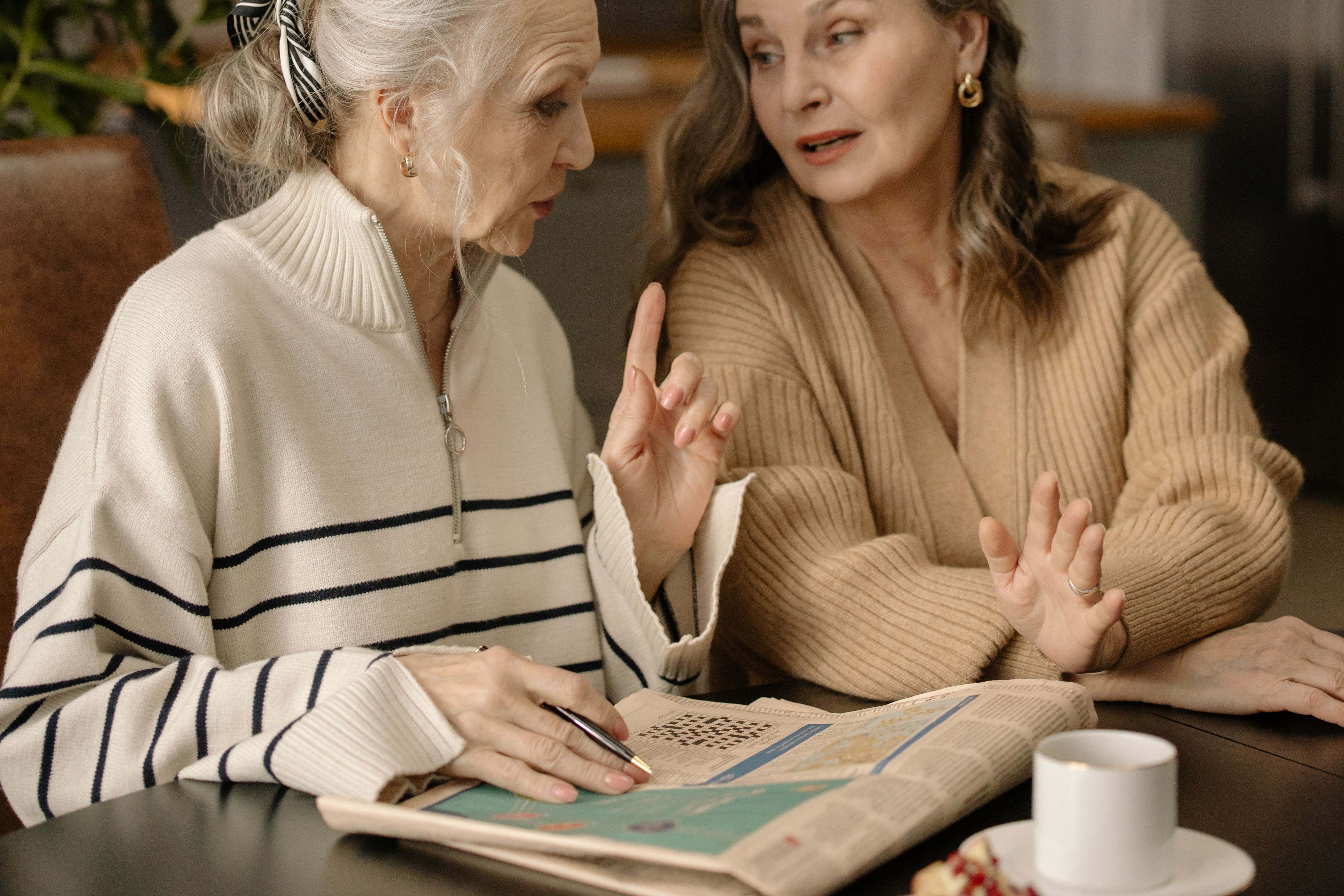
Cover photograph: cottonbro studio / Pexels, photograph 6939469, under the Pexels Licence. Illustrative conversation only; no endorsement or connection to the fictional story is implied.