DORKK JOURNAL Mathematics
The Same Fence, a Different Garden
Twenty metres of imaginary fencing reveals a surprising difference between perimeter and area, with a Grade 6 CAPS connection for South African families.

There are twenty metres of fencing and two plans for a garden. One plan is long and narrow. The other is shorter and wider. Both use every metre of the fence.
“Then they must give us the same amount of garden,” someone says.
It sounds reasonable. Nobody has bought more fencing or removed a section. The materials have stayed the same, so surely the space inside has stayed the same too?
On squared paper, the idea begins to unravel. The first rectangle contains sixteen little squares. The second contains twenty-four. The boundary has kept its length, but the surface inside it has grown.
This garden is an invented example, not a report about a school, family or building project. Its twenty metres are deliberately simple. We are imagining a flat rectangle with all four sides fenced, no existing wall, no gate opening and no allowance for posts or construction. A real garden would bring other questions.
For now, the surprise is enough: keeping one measurement unchanged does not necessarily keep another measurement unchanged. That makes a small garden plan a useful doorway into mathematical reasoning, especially for South African learners exploring area and perimeter.
Two journeys around the same fence
Start with a rectangle eight metres long and two metres wide. Imagine walking around its edge. You travel eight metres, turn, walk two, turn again, walk eight, and finish with another two. The complete journey is twenty metres.
Now change the plan to six metres by four metres. The journey becomes six, four, six and four. It is still twenty metres.
That journey measures the perimeter: the total distance around the boundary. You can follow it with a finger on a drawing or count the lengths of the four sides. You do not need to step into the middle of the garden to trace it.
Area asks a different question. How much flat surface lies inside that boundary? Imagine covering the first garden with square mats, each one metre along every side, without gaps or overlaps. Two rows of eight mats cover it. The second garden takes four rows of six mats.
The first needs sixteen square metres of covering. The second needs twenty-four. There are eight extra square metres inside exactly the same length of fence.
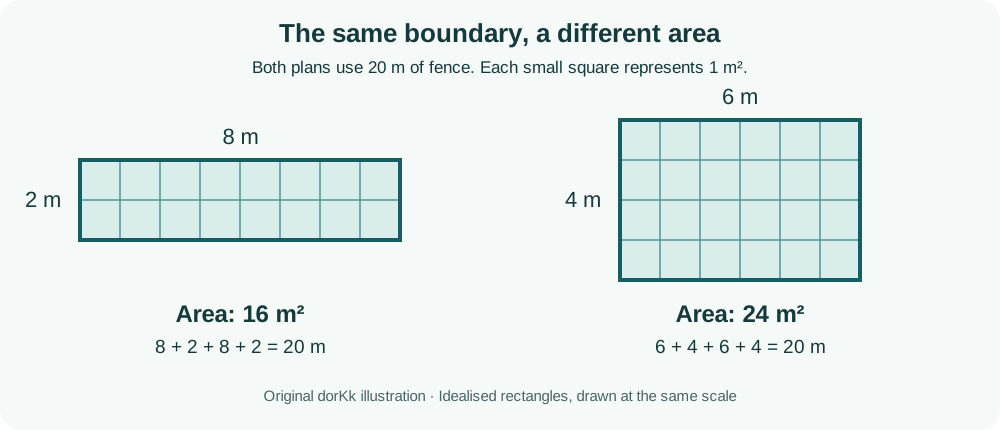
Original diagram for this article. Each small square represents one square metre; both boundaries measure twenty metres.
Why “bigger” is an awkward word
Which rectangle is bigger? Without saying what we are comparing, the question is incomplete.
The eight-by-two rectangle is longer. The six-by-four rectangle is wider and covers more surface. Their perimeters are equal. Each answer refers to a different property of the same two shapes.
Everyday conversation can manage with a loose word like “bigger”. Mathematics often asks us to make it more precise. Do we mean a greater length, more surface, a longer boundary, or something else?
The units help keep the question straight. Metres measure the length of the fence. Square metres measure the surface the imaginary mats cover. A square metre is a square unit with sides one metre long, not another name for a metre.
This distinction also explains why a bare answer such as “twenty” is unfinished. Twenty what? A drawing with twenty small squares inside it is showing something different from a boundary made of twenty unit-length edges. The number may match while the thing being counted does not.
The prediction deserves a hearing
The mistaken prediction at the beginning is worth discussing before correcting it. The learner has noticed something true: the fence length has not changed. The difficulty lies in deciding what follows from that fact.
An adult can ask, “Which part of the plan are you keeping the same?” Then, “How could we check the space inside?” Those questions give the learner’s reasoning somewhere to go.
Simply supplying two formulas may produce the correct numbers without resolving the original puzzle. A learner can calculate sixteen and twenty-four yet remain unsure why the fence has not grown. Comparing the boundary edges with the covered squares makes the two measurements visible in different ways.
There is no need to present the original answer as foolish. A useful mathematical conversation can begin with a plausible prediction, test it, and replace it with a more careful statement. Here that statement is: rectangles with the same perimeter can have different areas.
The word “can” matters. Equal perimeters do not force the areas to differ either. Turning an eight-by-two rectangle so it stands upright changes neither its perimeter nor its area.
A South African study gives the confusion a local context
In a 2016 Pythagoras paper, France M. Machaba examined area-and-perimeter understanding among thirty Grade 10 learners at one school in Soshanguve. They completed a written test; six were interviewed, and the article reports three selected interviews.
The reported reasoning included treating unchanged perimeter as evidence of unchanged area, and relying on a rectangle calculation without a secure account of what area measures.
This is a small qualitative case study, based on the author’s earlier 2005 research. It is not a national estimate, a test of today’s CAPS implementation or an experiment showing that a particular teaching activity improves marks. The author’s explanations of possible causes should not be mistaken for demonstrated causes.
Its value here is narrower: it documents the kind of conceptual confusion our fictional garden exposes, in a South African educational setting. It gives us a reason to listen to the explanation behind an answer, rather than assuming that an older learner must already find the distinction obvious.
Every rectangular plan the twenty metres can make
The two garden plans are not the only possibilities. Keep all four sides, keep the total fence at twenty metres, and for this investigation use positive whole-number side lengths in metres.
The adjacent sides must add to ten, because each appears twice on the way around. That gives a manageable set of rectangles. Rotating a rectangle does not create a new pair of dimensions.
| Side lengths | Perimeter | Area |
|---|---|---|
| 9 m and 1 m | 20 m | 9 m² |
| 8 m and 2 m | 20 m | 16 m² |
| 7 m and 3 m | 20 m | 21 m² |
| 6 m and 4 m | 20 m | 24 m² |
| 5 m and 5 m | 20 m | 25 m² |
The table tells a more interesting story than a single calculation. As the sides become closer in length, the area increases in this set. The five-by-five square encloses the most surface among the listed choices.
Why stop there? Six by four would repeat four by six, and the same applies to the other reversed pairs. Ten by zero would have no width, so it would not be a garden rectangle with a positive area.
These are all the positive whole-number choices under our rule, not all possible rectangles. A side could be four and a half metres long if fractions were allowed. Stating the rule makes the claim about the table honest.
Where the extra surface comes from
Look closely at the change from eight by two to six by four. The sum of adjacent side lengths stays ten: two metres come off one dimension and two are added to the other. That preserves the boundary total.
But the surface is organised into rows. Two rows of eight squares become four rows of six squares. Each new row is shorter, yet there are twice as many rows. The two changes do not cancel in the count of squares.
A pencil sketch can show this without any advanced algebra. Mark sixteen squares in an eight-by-two array. Beside it, mark twenty-four in a six-by-four array. Count by rows, then count by columns. Both routes should describe the same surface in each drawing.
This is also a good place to slow down over the word “same”. The same fence has not become the same collection of floor squares. The boundary and the covering are different quantities, and each needs its own check.
Turn the puzzle around
Now imagine that the amount of ground is fixed instead. We want a rectangular patch covering twenty-four square metres. How much fencing will it need?
A six-by-four rectangle needs twenty metres around its edge. An eight-by-three rectangle covers the same twenty-four square metres but needs twenty-two metres of fence. A twelve-by-two rectangle still covers twenty-four square metres and needs twenty-eight metres around it.
The covered surface stays constant while the boundary changes. This is the original surprise in reverse.
Equal-sized paper squares offer a simple way to represent it. Arrange twenty-four of them into rows of six, then into rows of eight. The same pieces cover the same total surface, but the outline becomes different. A drawing of the arrangements works just as well, with no cutting required.
When counting the outline, count only the exposed unit edges. The line where two neighbouring squares meet is inside the shape, not part of its outer boundary. Counting every side of every tile would count many internal joins that no fence needs to follow.
A longer fence can surround a smaller space
There is a tempting replacement rule: perhaps perimeter and area are different, but a larger perimeter must at least mean a larger area.
Compare a nine-by-one rectangle with a four-by-three rectangle. The long, narrow shape has a perimeter of twenty metres and an area of nine square metres. The shorter-boundary shape has a perimeter of fourteen metres and an area of twelve square metres.
Here the longer fence encloses less surface. That pair is a counterexample: one valid case that disproves a claim saying the relationship must always hold.
The conclusion should stay just as precise. We have not shown that a longer boundary always means less area. We have shown that boundary length alone does not settle the area comparison.
This is an important form of reasoning beyond geometry. When someone says “always”, searching for one case that breaks the rule can be more revealing than collecting several examples that happen to fit it.
When both sides grow together
Another change produces a different pattern. Begin with a rectangle three metres by two metres. Its perimeter is ten metres and its area is six square metres.
Double both side lengths. The new rectangle is six metres by four metres. Its perimeter becomes twenty metres, twice the original. Its area becomes twenty-four square metres, four times the original.
Imagine the larger rectangle divided into four smaller rectangles, each three by two. Two copies fit across and two fit down. Doubling in two directions creates four copies of the original surface.
This example does not keep the fence fixed, so it answers a different question from the first garden. Comparing the two situations helps expose a hidden condition: which measurements are allowed to change?
A learner who can explain that condition is doing more than recalling a calculation. They are deciding what kind of comparison the problem permits. An adult can ask for a sketch of the four copies rather than asking the learner to memorise another isolated rule.
The CAPS connection is unusually direct
The Department of Basic Education’s Mathematics CAPS for Grades 4–6, published in 2011, includes this relationship in Grade 6 measurement, topic 4.6. Printed pages 282–283 discuss rectangle-and-square area and perimeter, including finding different areas from a given rectangle perimeter.
The guidance retains counting grid squares and exploring why rectangle area can be found through length multiplied by width. It explicitly says that memorising and applying area-and-perimeter formulas is not required in the Intermediate Phase.
That makes a drawn, counted and explained investigation more appropriate here than treating formula recall as the whole task. Teachers should still use their current teaching plans and assessment instructions to decide timing and expected work. This article is supplementary material, not an official assessment or a claim of DBE endorsement.
What a drawing can reveal that an answer hides
Ask a learner to show the fence in one colour and the covered ground in another. Then invite them to point to the part of the drawing each number describes.
If they colour the inside but count boundary marks, the picture makes the mismatch available for discussion. If they count grid intersections instead of square spaces, ask them to shade one complete unit of area. If they count internal tile joins as fencing, follow one uninterrupted journey around the outside together.
These are possible responses to inspect, not a checklist for diagnosing a child. A single confusing drawing does not tell us why the learner is having difficulty. Wording, the grid, attention to units or an unfamiliar task could each need clarification.
In NRICH’s practitioner article on teaching area, Alison Kiddle argues for considering what the two quantities mean together rather than relying only on neighbouring formulas. That is pedagogical commentary, not an evaluation of this garden activity. The practical choice here is to make the quantities visible enough for a learner to discuss.
A useful model still has limits
Would the square plan always be the best real garden? Our investigation cannot answer that.
A real site might be narrow, sloped or shaded. There may be paths, an existing wall, drainage requirements or space needed to reach the plants. Changing those conditions changes the problem. Even the instruction to fence all four sides matters: a boundary already provided by a wall would make the twenty metres available for a different arrangement.
The whole-number rectangle table also says nothing about every other possible shape. A conclusion about the best choice in that table should not quietly become a claim about all gardens.
This does not make the mathematics useless. It makes the model’s job clearer. It isolates one relationship so we can understand it. Then, when another condition enters, we can ask which part of the reasoning still applies.
For home discussion, squared paper and a pencil are enough. Nobody needs to buy fencing, handle sharp tools or measure a real property to explore the question.
Where a lesson video fits
A prerecorded explanation can give a learner another way to see the boundary and the surface. Pause when the first rectangle appears and ask what will stay unchanged when it is reshaped. Make a prediction before watching the calculation.
After the explanation, try a different pair of side lengths. The useful question is whether the learner can show what the numbers mean without simply reproducing the example on screen.
dorKk provides supplementary prerecorded CAPS-aligned lessons for South African learners. It is not an online school and does not replace school teaching, assessment or qualifications. Check the subject catalogue for the grade, language and topic needed. This article does not claim that a particular perimeter-and-area video is available or that the activity has been tested by dorKk.
The garden at the end of the page
The fence is still twenty metres long. Nothing has been added to it. Yet the drawings now show why it can surround sixteen square metres in one arrangement and twenty-four in another.
A learner who can explain this has something more useful than an instruction to add for one question and multiply for another. They can follow a boundary, cover a surface, name the units and explain which measurement a change preserves.
The original prediction was understandable. Testing it did not require an elaborate experiment or an expensive resource. It required two rectangles and enough attention to ask what, exactly, had stayed the same.
Sources and further reading
- Machaba, F.M. (2016), The concepts of area and perimeter: Insights and misconceptions of Grade 10 learners, Pythagoras, 37(1), a304. Original South African case study; limits are explained above.
- Department of Basic Education (2011), Mathematics CAPS, Grades 4–6, Grade 6 topic 4.6, printed pp. 282–283. Official curriculum context.
- Alison Kiddle (18 December 2012), Some Thoughts on Teaching About Area, NRICH, University of Cambridge. Practitioner commentary.
- Lianne Aubert Sanfeliz (September 2019), A Pathway to Understanding Area and Perimeter, Yale National Initiative, unit 19.05.01. Additional practitioner reading; written for a US Grade 3 context, not a South African CAPS prescription or intervention trial.
Photo: Antoni Shkraba / Pexels, used under the Pexels Licence. Diagram: original illustration prepared for this dorKk article.