DORKK JOURNAL Science Learning
The Paper Helicopter That Wouldn’t Give a Straight Answer
A paper helicopter opens a practical conversation about fair comparisons, uncertain measurements and what a learner’s science results can actually show.
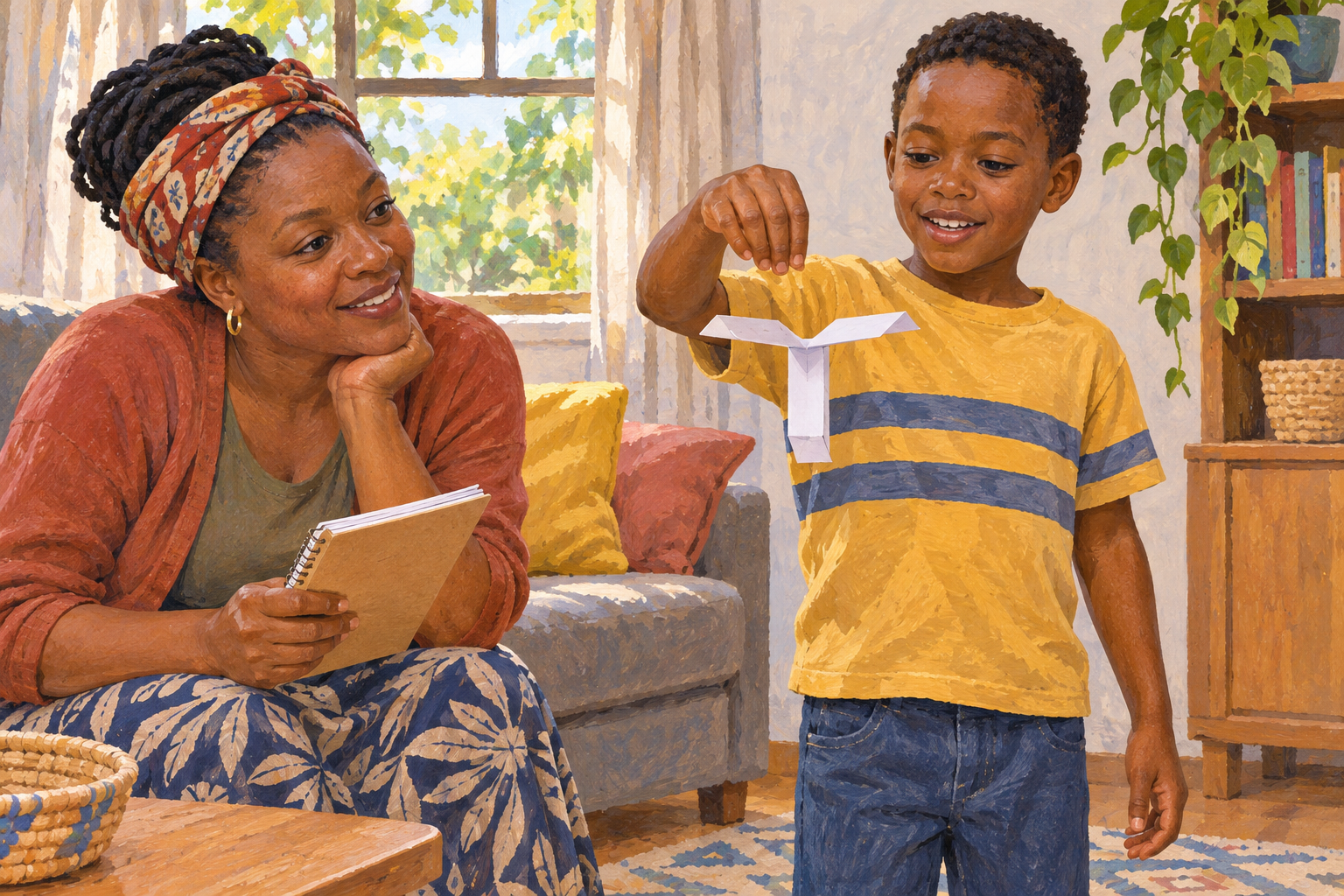
A folded piece of paper drops towards the floor, turns once, wobbles, and lands beside a chair. On the next attempt it spins beautifully. On the third it seems to fall faster than before.
Which attempt tells the truth?
All three might. That is what makes this modest activity worth more than a perfect demonstration. It gives a learner something real to think about: a result that refuses to behave exactly as expected.
This opening is an imagined home-learning scene, not a report about a dorKk learner. But the question behind it is useful in an ordinary South African home or classroom. When we say an experiment “worked”, do we mean it looked impressive, gave the answer we wanted, or helped us discover something we can reasonably defend?
A paper helicopter offers a way into that distinction. The aim is not to turn the lounge into a laboratory, buy a science kit, or produce a display worthy of a competition. It is to make a small claim, collect evidence and decide how much that evidence actually allows us to say.
A small object with a remarkable relative
On 19 April 2021, NASA’s Ingenuity made the first powered, controlled flight on another planet. The official mission record describes an experimental aircraft carried to Mars with the Perseverance rover. It is a compelling historical starting point for a conversation about designing, testing and learning.
A falling paper rotor is not a miniature working version of Ingenuity. It has no motor producing powered flight, and a living room is not the Martian environment. Calling it a “helicopter” is a convenient description of its appearance and turning movement, not permission to treat the two machines as physically equivalent.
That distinction is part of the lesson. Models can help us investigate a question without reproducing every feature of the thing that inspired them.
NASA JPL offers an accessible paper helicopter activity and template. Families can use the official resource for construction guidance rather than trying to infer a folding pattern from a photograph. The discussion below is an original guide to thinking about a small investigation, not a reproduction of NASA’s lesson or a required school assessment.
For home use, keep everyone on the floor. Use a clear indoor space, supervise scissors and release the paper from a comfortable, reachable height. There is no need to climb on furniture, lean over stairs or use a balcony to make the experiment more interesting.
The question matters more than the winner
Imagine a learner makes two paper rotors. One is large and neatly folded. The other is smaller, made from thicker paper and bent at a different angle. The smaller one reaches the floor first.
“The big one is better,” the learner announces.
There are two problems hiding in that sentence. Better for what? And which of the many differences caused the result?
If the aim is a slow descent, the time to reach the floor matters. If the aim is landing near a chosen spot, sideways movement matters. If the aim is making something easy to build, neat spinning might not be the main concern at all. Before deciding which design wins, agree on the question it is supposed to answer.
For a manageable first investigation, try: “What happens to the time taken to reach the floor when we release this same paper rotor from two different heights?”
This question is deliberately modest. It uses one object, changes something visible and asks for an observation that can be recorded. It does not ask a beginner to explain the complete aerodynamics of a spinning object before getting started.
Choose two reachable release heights and mark them against a fixed reference, such as a wall away from obstacles. Measure and record the heights if you have a suitable measuring tape. If not, describe your reference points honestly rather than inventing centimetres. Use the same landing surface and a clear starting rule: release the paper without throwing it.
The important improvement is not that the question suddenly sounds scientific. It is that another person can understand what is being compared.
What a fair comparison can, and cannot, do
In this proposed investigation, release height is the feature deliberately changed. Time to the floor is the outcome observed. Paper, folds, landing surface and release method should stay as consistent as reasonably possible.
The Australian Academy of Science’s Primary Connections guidance on fair tests distinguishes changed, measured and controlled variables. That is useful teaching guidance from Australia, not a South African curriculum rule. In everyday language, ask: “What are we changing? What are we watching? What should stay the same?”
Those questions are more useful than chanting “change one thing” without looking at the actual objects. A paper rotor may become creased after several drops. A person may accidentally push it. Someone may open a door. Writing “everything else stayed the same” does not make those possibilities disappear.
Nor can every investigation be a fair test of this kind. Watching cloud shapes, sorting leaves or describing an animal’s behaviour can involve useful observation without deliberately changing a single variable. The method should fit the question. Here, the comparison is practical precisely because the family can choose the release heights and reuse the same object.
Even then, its conclusion should remain small: what happened to this rotor, under these conditions, using this way of measuring. That is enough for a worthwhile conversation.
The stopwatch introduces its own problem
The paper reaches the floor quickly. A child starting and stopping a timer must react to both events. An adult must do the same. The display may show hundredths of a second, but that does not mean the measurement is accurate to a hundredth of a second.
This is a useful distinction between what a tool displays and what a method can reliably detect. A result written as 1.37 seconds looks precise. It may still depend noticeably on when someone pressed the button.
Try a few practice releases before collecting results. Agree that timing starts when the paper leaves the hand and ends when it first touches the floor. Keep the same person on the timer for the comparison if possible. Record any obvious interruption, such as the rotor hitting a chair, instead of quietly treating it as an ordinary fall.
If timing is too difficult, simplify the question. Record whether the rotor turned before landing at each height, using a clear definition everyone understands. That changes the investigation, and the conclusion must change with it. You are now discussing an observed movement, not claiming to have measured a difference in descent time.
A family with a phone may choose to review a short recording, but recording is optional. Keep children’s videos private, avoid capturing other people and do not upload them simply to complete the activity. More equipment is not automatically better evidence if nobody understands what is being measured.
Repetition gives the awkward result somewhere to belong
One drop offers one observation. A few drops let you notice whether the result is stable or variable. Decide on a manageable number before starting, and use the same number at each height. Five attempts at each height would be a reasonable small practice exercise, not a scientifically guaranteed sample size.
Alternate the heights rather than completing every low release before every high release. This is a practical suggestion for the example: it can make a gradually damaged fold or improving timer technique easier to notice across both conditions. It does not remove every source of error.
Keep a simple record with the height, attempt number, result and a short note. A messy honest note is more useful than a beautifully copied number whose origin has been forgotten.
Here is a hypothetical set of results, invented only to illustrate interpretation. It is not experimental evidence or a prediction of what your rotor will do:
- Lower release: 0.8, 0.9, 0.8, 1.0 and 0.9 seconds.
- Higher release: 1.1, 1.0, 1.2, 1.1 and 1.1 seconds.
The averages are 0.88 seconds and 1.10 seconds, a difference of 0.22 seconds. Every higher-release time exceeds or equals the lower group’s largest value. That is a pattern worth describing, but these ten invented numbers cannot establish how a real rotor behaves.
With real observations, ask whether the difference looks substantial relative to the variation between attempts and the limitations of hand timing. A small numerical difference is not automatically a meaningful finding. Repeating an uncertain measurement does not magically make the method accurate.
If one attempt is unusual, investigate before removing it. “It hit the chair” is a recorded reason to flag an interrupted trial and repeat it under the agreed conditions. “It spoiled our average” is not.
A conclusion should fit through the doorway of the evidence
Compare these two imagined conclusions:
“Higher helicopters always fly better.”
“In our indoor test, this paper rotor usually took longer to reach the floor from the higher release point. Our hand timing was rough, and we tested only one rotor.”
The second sentence is less dramatic and much more useful. It identifies the object, the comparison, the observed outcome and the limits. It does not pretend that a falling rotor flew under its own power or that one exercise settled a universal rule.
For a younger learner, shorten it: “Ours usually took longer from the higher mark. We need to check again.” The idea matters more than adult-sounding vocabulary.
A parent can ask three follow-up questions without supplying the answer: “Which results support that?”, “Was there anything that made the test difficult?” and “What would you change if you tried again?” These are suggested conversation prompts, not a validated intervention promising better marks.
If the expected pattern does not appear, the activity has not necessarily failed. Perhaps the release heights were too similar for the timing method. Perhaps the rotor changed shape. Perhaps the observations are genuinely unclear. An honest “we cannot tell from this test” is a defensible conclusion.
Where this belongs in South African learning
South Africa’s CAPS Natural Sciences and Technology policy for Grades 4–6, the 2011 document linked from the DBE’s Intermediate Phase CAPS page at the time of checking, includes observing, measuring, predicting, planning investigations, recording and interpreting information among its process skills. Sections 2.6 and 2.7 connect practical work with understanding.
That provides context for this article’s emphasis on evidence. It does not make this particular home activity an approved assessment, establish a term assignment or replace a teacher’s instructions. Check the learner’s current school plan and task requirements before attaching a grade or assessment label to it.
The experience can also be adjusted without pretending every learner needs the same worksheet. One learner might describe what happened aloud. Another might write a short comparison. A learner already comfortable with averages might calculate them and discuss their limitations. An adult can handle the cutting while the learner chooses the question and records observations.
These are practical adaptations proposed for this activity, not claims that a specific approach has been tested with every age group or learning need. The teacher remains the best source for the required terminology, content and assessment expectations.
A lesson video is a place to pause, not a substitute for noticing
A recorded explanation can be useful before or after a practical question. Beforehand, it may introduce a word the learner needs. Afterwards, it may help connect an observation with a fuller explanation. Neither use requires pretending that watching and investigating are the same task.
Try asking the learner to pause after a claim and say what they would expect to see if it were correct. Return to the explanation after making observations. If the observation and explanation seem to disagree, check the conditions and the meaning of the words before deciding that either must be wrong.
dorKk provides supplementary prerecorded curriculum lessons. It is not an online school or a qualification issuer. Check its current catalogue for the subject and topic you need rather than assuming a paper-helicopter lesson exists. The company’s editorial standards also distinguish supporting resources from school requirements.
The broader aim is a useful learning habit: connect an explanation to a question, and connect a conclusion to something actually observed. This article does not claim that the suggested activity, or a video platform, produces a particular improvement in attainment.
Questions families may ask
Must the prediction be correct?
No. Write what you expect before testing, with a reason if you can. Afterwards, compare that expectation with the observations. Changing your mind because of evidence is more useful than rewriting the prediction to make it look correct. If this is assessed schoolwork, follow the teacher’s instructions about recording both stages.
Do we need a printer or special materials?
No expensive kit is proposed here. The linked NASA resource includes construction guidance, but an adult should check which materials and steps suit the learner. Ordinary paper is sufficient for the discussion. If making a rotor is impractical, examine an existing safe classroom activity and ask the same questions about what changed and what was observed.
What if the results are all different?
Keep them. First check for obvious differences in release method, damaged paper or interruptions. If there is no clear explanation, describe the uncertainty rather than selecting a favourite attempt. You may need a clearer question or a measurement method that can distinguish the outcomes you are comparing.
Should we make the best design instead?
You can, but recognise the different purpose. Improving a design may involve trying several changes together. That can produce a useful object while leaving you unsure which change mattered. A comparison intended to isolate one influence needs a more controlled plan. Both kinds of activity have value; they answer different questions.
What should we keep afterwards?
Keep the question, a brief description of the comparison, the original observations and the conclusion. A photograph of the object can help you remember its shape, but photographs of children are unnecessary. A short record that another person can understand is enough. There is no need to turn a small investigation into a glossy presentation.
The worthwhile answer may be a better question
Return to the rotor beside the chair. The interesting part is no longer whether it spun attractively. It is the learner noticing that one release was a little higher, that the fold changed, or that a timer cannot confidently distinguish two very short falls.
Those observations offer a next question that belongs to the learner: “How could we check that more fairly?”
A good afternoon of science does not need a spectacular result. It needs room to notice, a record that has not been tidied into fiction, and an adult willing to accept an uncertain answer. The paper can go into recycling. The habit of asking what the evidence actually shows is worth keeping.
Sources and further reading
Accessed 6 November 2026. Links support specific factual context, not a claim that this original activity has been evaluated or endorsed.
- NASA JPL, Ingenuity mission: historical flight milestone and mission identity.
- NASA JPL Education, Make a Paper Mars Helicopter, updated 15 October 2024: optional construction resource. This article uses a floor-only safety approach.
- Australian Academy of Science, Primary Connections, Conducting fair-test investigations, updated 13 November 2025: Australian pedagogical guidance on variables and comparisons.
- South African Department of Basic Education, Intermediate Phase CAPS index and the 2011 Natural Sciences and Technology Grades 4–6 policy, sections 2.6–2.7: curriculum context, not current school scheduling.
- dorKk, website and editorial standards: service description and limits of supporting resources.