DORKK JOURNAL Parent Support
Who Is Holding the Pencil? Helping With Homework Without Taking Over
Practical homework support for South African families: help learners ask better questions, use resources and keep ownership of their work without taking over.
The homework is finished. Every answer is neat, the spelling has been corrected and the project looks ready for the classroom. There is only one awkward question: how much of it could the learner explain tomorrow without the adult who sat beside them tonight?
Consider a fictional evening in a South African home. A learner has to write a paragraph comparing two places described in class. A parent reads the instructions, suggests an opening sentence, improves the vocabulary and rearranges the final lines. The child copies the paragraph. Both feel relieved. Something has been submitted, but it is difficult to tell whether the learner can make a comparison or whether the parent can.
Now imagine a less polished version of the same evening. The learner chooses two differences, explains them aloud, writes a rough paragraph and marks one sentence they are unsure about. The adult helps them find the class example and agrees that the uncertain sentence is a useful question for tomorrow. There may still be mistakes on the page. There is also a clearer record of the learner’s thinking.
All family scenarios and sample conversations in this article are invented illustrations, not accounts of dorKk customers. They illustrate a question many families can use: what kind of help leaves the learner better able to take the next step? Answering that question is more useful than deciding that good parents must either supervise every line or leave children entirely alone.
A supporting role that does not require knowing every answer
Homework can put adults in an uncomfortable position. They may remember a different calculation method, be less confident in the language of instruction, or arrive home after a long working day. A grandparent, older sibling or other caregiver may be the person available to help. None of these circumstances should be treated as evidence that a family does not care about education.
South Africa’s Department of Basic Education provides a Parents and Guardians resource page that describes education as a partnership and links practical guidance for supporting children at home and at school. Its parent resources are a useful starting point for local context. They are not a requirement that every adult become a subject specialist, and this article does not interpret them as a universal homework policy. Your child’s teacher remains the best person to clarify the purpose and expectations of a particular assignment.
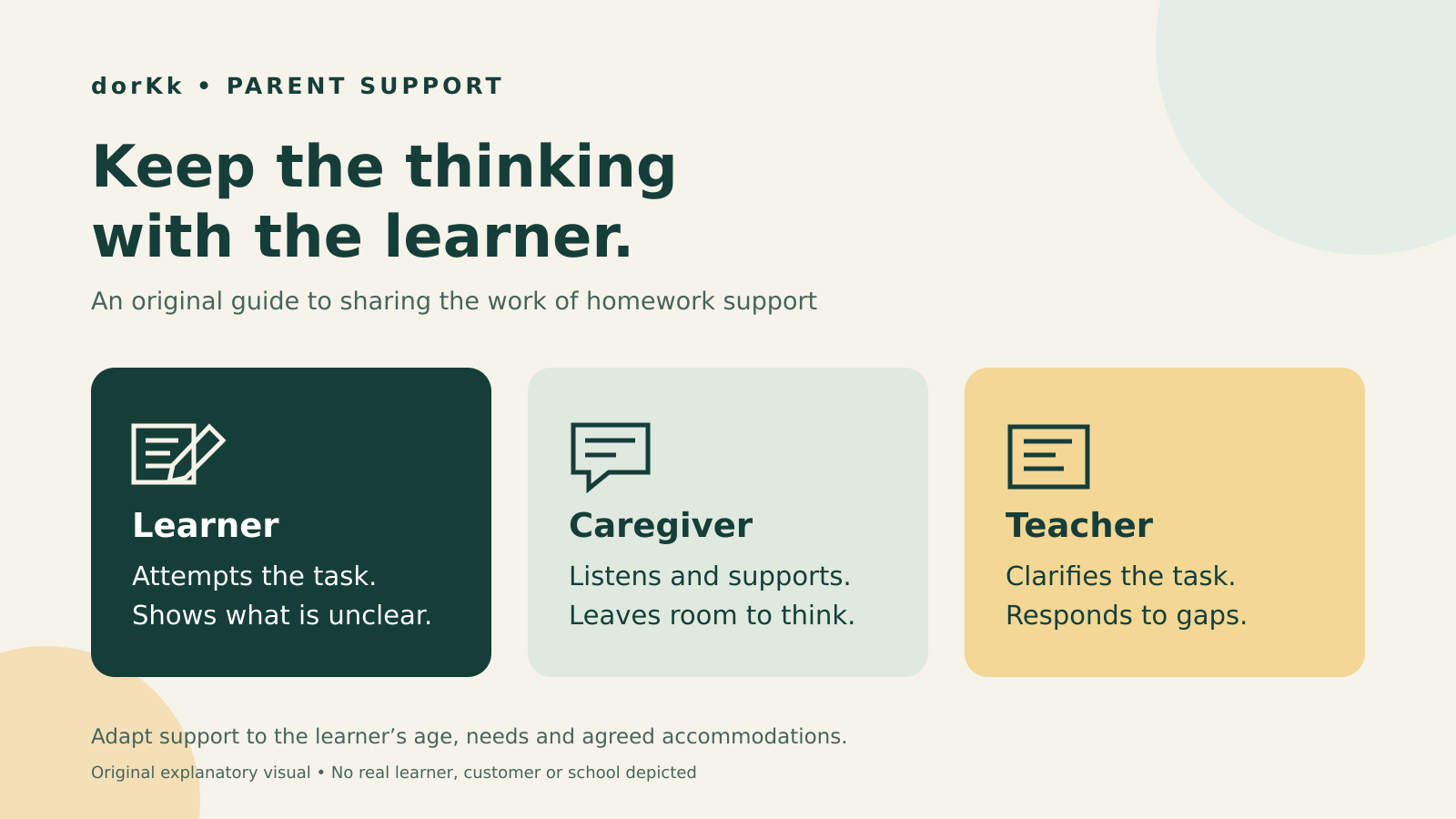
A practical division of responsibility is possible. The learner attempts the work and explains what is difficult. The adult helps create a workable opportunity to begin, listens and helps identify the right source of support. The teacher explains what learning the task is intended to reveal and responds to gaps that remain.
That division will look different for a child learning to read, a teenager completing an assignment, and a learner who uses an agreed accommodation. Independence should fit the learner’s needs. A child who dictates to a scribe can still own the ideas. A child physically holding a pencil can still be copying an adult’s thinking. The title’s question is about ownership of the learning, not a rule about who must physically write.
What the research can tell us, and what it cannot
Research on parental involvement is more complicated than the slogan “more help means better results”. England’s Education Endowment Foundation guidance on parental engagement cautions that interventions encouraging direct parental involvement in homework are not generally linked to increased attainment. It suggests supporting planning and learning habits, and referring subject difficulties back to teachers, rather than assuming parents should supply instruction. This is evidence-informed guidance developed for education settings, not proof that an individual act of help is harmful.
A 2018 primary study by Xu and colleagues followed 336 Grade 9 learners in two schools in southeastern China at two points during a school year. Support for learners’ own initiative was associated with later mathematics achievement. The findings for direct content help differed: it was associated with later effort but lower later achievement. The researchers explicitly caution that these are not causal effects. The reported effect sizes were small. The sample was limited, and support and effort were measured through learner reports. This cannot establish what will happen in a South African household or justify withholding needed teaching.
Together, these sources provide a reason to examine the kind of support being offered. They do not supply a guaranteed script, an ideal number of minutes, or a predicted mark increase. The conversations and routines below are original practical suggestions to adapt with a teacher, rather than a tested intervention package.
Notice where the difficulty begins
“I don’t understand” is an important message, but it is not yet a precise description of the problem. Before supplying an explanation, try to find the point where the learner lost the thread. One child cannot interpret the instructions. Another understands the task but cannot recall the method. A third knows the method and is struggling to organise a long piece of work.
A useful opening is: “Show me what you have been asked to do, and show me where it stops making sense.” Let the learner point, speak, sketch or demonstrate. Avoid turning this into a rapid series of questions. If they cannot explain the whole task, start with the first instruction or the class example that appears closest to it.
Imagine an invented task asking for similarities and differences between two environments. A learner says they cannot write the answer. Rather than beginning with a better opening sentence, ask whether the difficulty is choosing the information, understanding the word “compare”, or putting an idea into a sentence. Each answer suggests a different next move.
If the instruction is unclear, the learner may need clarification. If information is missing, they may need to find the relevant notes. If expressing the idea is difficult, speaking it aloud may provide a starting point. An adult does not need to decide immediately which category explains everything. The aim is to replace a vague struggle with one manageable question.
This approach also protects against an easy misunderstanding: a child who needs more explanation is not necessarily refusing to work. Before discussing effort, check whether the assignment, materials and expected starting point are actually available.
Offer a small amount of help, then watch what happens
Once the difficulty is clearer, choose a response that leaves something meaningful for the learner to do. That could mean finding the relevant page together, explaining an unfamiliar instruction, or suggesting a single comparison to consider. Then pause. Ask the learner to use that support on the next part rather than continuing to talk through the whole assignment.
For example, suppose a fictional learner is writing about a story and keeps retelling events instead of explaining a character’s decision. A parent might point back to the question and ask, “Which decision are you being asked about?” Once the learner identifies it, the next step belongs to them: choose a detail from the story and explain why it matters. The adult need not compose the sentence.
Sometimes an explanation is genuinely needed. If you know the subject and the teacher’s approach, offer a short explanation and let the learner try a different example. If you are unsure, say so. “I learnt another method, so let’s check the example from class before I confuse you” is a reasonable response. Guessing with confidence creates another problem to untangle later.
You can also ask what sort of support the learner wants: listening while they explain, help locating a resource, or checking whether they have understood the instructions. Younger learners may need concrete choices rather than an open question. An older learner may prefer a few minutes to attempt the task before discussing it.
The amount of help can change. If a prompt does not help, another explanation may be appropriate. If the learner can continue, step back. The goal is not to ration assistance or prove that they can struggle unaided. It is to avoid letting an adult’s understandable wish to finish quickly remove every decision from the learner.
Make an honest attempt visible
The difference between completing work and understanding it can be hard to see on a spotless page. A more informative record might include the learner’s attempt, a correction and a short question. Follow the teacher’s instructions about how work should be presented, but resist quietly replacing every error before the teacher sees it.
Take a fictional spelling activity. The learner writes a word incorrectly. Instead of erasing it and dictating the correct version, an adult could ask which source the class has been told to use for checking. The learner checks that source, writes a correction and identifies the part they missed. The important detail is that the checking belongs to the learner, with support where needed.
For a longer writing task, ask the learner to read one paragraph aloud and identify the sentence that best answers the question. If none does, that is useful information. They can decide what is missing before anyone polishes the language. A beautiful paragraph that does not answer the task is still unfinished in an important way.
A brief note can help when the work remains incomplete: “I understood the first instruction, but I could not work out how to use the example for question three.” This is an invented model, not a prescribed school form. It is more specific than “I couldn’t do it” and more honest than an adult completing the question without explanation.
Avoid making every evening a formal assessment. A family does not need a spreadsheet of mistakes. One marked question or a short conversation can be enough to preserve what the teacher needs to know and what the learner needs to ask.
Build a routine around the home you actually have
Advice about a quiet room, a personal laptop and an available adult can sound simple until a family has none of those things. A workable plan begins with the real situation: shared space, household responsibilities, transport, available materials and the times someone can help. The plan should be usable on an ordinary evening, not only on the family’s easiest day.
Try agreeing on a small starting arrangement. Where will the books be kept? What needs to be checked before work starts? If a device is shared, which part of the assignment needs it and which part can be done on paper? If an adult is not available until later, what can the learner attempt first and what question should they save?
Here is a hypothetical arrangement, offered as an example rather than a recommended timetable. A learner checks the assignment after arriving home, sets aside the relevant book and attempts the part they recognise. When a caregiver is available, they discuss one marked difficulty. Before packing away, the learner checks whether the task is complete or whether a question must go back to school.
The arrangement can be shorter, more supported or split across different times. A younger learner may need someone alongside them to get started. A learner with additional support needs may require a specific plan agreed with school. The useful feature is that responsibilities are understandable, not that every family follows the same clock.
If access makes the task impossible, tell the teacher what is missing. “We cannot open the online resource at home this week; is there a paper alternative?” gives the school something concrete to respond to. Avoid buying an unfamiliar resource simply because a search result claims it will solve the problem.
Use a video as an explanation, not as the finished answer
A recorded lesson can be a useful place to revisit an explanation. It still leaves the question of what the learner does afterwards. Before opening a video, agree on the question it is meant to help with. Otherwise, a short homework difficulty can turn into a long sequence of unrelated videos without resolving the original task.
A simple routine to try is: identify the uncertain idea, watch a relevant explanation, pause, and attempt the next part using the learner’s own words or working. If that attempt remains unclear, note the specific step rather than replaying everything automatically. This is a suggested use pattern, not a claim that a particular viewing routine has been validated for every learner.
dorKk provides supplementary prerecorded South African CAPS curriculum lessons. It is not an online school or qualification provider. Check the current subject catalogue and the individual lesson’s grade, language and topic against the learner’s actual schoolwork before choosing a resource. No particular lesson or grade coverage is assumed in this article.
Keep the teacher’s assignment in view. A clear explanation from another source may use different terminology or a different sequence of steps. If that creates uncertainty, ask the teacher how the approaches relate. Finishing a video is not the same evidence as being able to explain or attempt the task afterwards.
Know when the next step belongs with the school
A question taken back to school is not a failed evening. Some difficulties require information that the family does not have: the intended method, an unclear instruction, missing teaching material, or the support arrangements for a particular learner. An adult should not have to reconstruct the lesson from a worksheet alone.
The Australian Education Research Organisation’s primary-school family engagement guide emphasises collaborative problem-solving and two-way communication. It also cautions against assuming that asking families to supervise or directly help with homework will improve learning outcomes. Its Australian primary-school scope matters; it supports a conversation with a school, not a universal rule for all ages or South African assignments.
Keep that conversation specific and respectful. A hypothetical message could say: “We looked at the class example and tried the first two questions. The instruction about evidence is still unclear. Could you show us what you expect in one answer?” The message describes what happened without blaming the teacher or labelling the child.
If similar difficulties keep appearing, collect a few examples and ask for a discussion. Do not wait for a perfect explanation of the cause. Nor should an ordinary struggle with homework become an amateur diagnosis. Ask what the school observes, what support is already available and what the family should do when the same problem appears again.
When a session becomes an argument, stop trying to improve the worksheet in the middle of that argument. Take a pause, agree what remains unresolved and return when it is workable. If distress is persistent or substantial, seek appropriate support through the school and, where needed, a qualified professional. Completing one assignment should not become the measure of a child’s worth or a family’s commitment.
Questions parents often ask
Should I correct every wrong answer?
Check the teacher’s expectations first. You can help the learner notice and investigate an error without replacing their response. If they cannot correct it after an appropriate attempt, preserve the question for the teacher. A page showing where understanding breaks down can be more informative than work silently rewritten by an adult.
What if my child asks me to sit beside them the whole time?
Start from what they can manage now. Agree on a small part they will attempt while you are nearby but not directing every move, then check in. Adapt this with the teacher where there are additional needs. There is no universal age or timetable by which every learner must work alone.
What if I do not understand the subject or the school language well?
You can still help identify the task, organise materials and communicate a clear question to the teacher. Ask the school which explanations or support options it recommends. Do not assume that an unfamiliar method is wrong, or that buying extra materials is the only way to help.
Is it acceptable to leave homework unfinished?
An honest attempt and a specific explanation are preferable to pretending the learner understood. Follow the school’s homework policy, tell the teacher what prevented completion and ask what to do next. This is not advice to ignore assignments; it is a way to make unresolved learning visible.
A better question at the end of the evening
“Is it finished?” remains a practical question. Try adding another: “What can you now do, and what do you still need help with?” The answer may be modest. A learner may have found the right example, written an imperfect paragraph, or learned to ask a more useful question.
Those small outcomes keep the next step clear. Parents and caregivers can offer attention, structure and support without having to become the author of the work. The aim is an evening in which the learner has done some real thinking, the adult knows where help is needed, and the teacher receives an honest picture of what comes next.
Sources
Accessed 4 November 2026. Source jurisdictions and research limitations are described in the article. No percentage improvement or predicted academic outcome is claimed.
- South African Department of Basic Education, Parents and Guardians. Official parent resource page; not treated as a universal homework policy.
- Education Endowment Foundation, Parental engagement. England-based evidence guidance; international applicability requires care.
- Xu, J., Du, J., Wu, S., Ripple, H. and Cosgriff, A. (2018), Reciprocal Effects Among Parental Homework Support, Effort, and Achievement? An Empirical Investigation. Primary longitudinal study, two Chinese schools, observational associations, not causal effects.
- Australian Education Research Organisation, Engaging with families to support student learning in primary school. Official Australian evidence-informed practice guide.
- dorKk, website and subject catalogue. Used for brand context only, not as educational efficacy evidence.